

The good old days… reflecting on what we have.

I often reflect on the last few decades, and marvel at the changes that we’ve all grown to accept as normal in our daily lives. I often wonder if we could live without the technology we have today.
Without showing my age, when I was young, we had one of those phones with the rotating dial. Every time you dialed a number, those rotating dials seemed to go slower and slower.
We also had a big black and white TV with doors that made it look like a cabinet when not in use. It was called, coincidently, a TV cabinet. Unlike today, the signal stopped at midnight, not that I ever stayed up that late, because ’sleepy bear’ always came on at 7.30pm to remind us kids that it was time for bed. I hated that bear.
| Shane Drew has been involved in the sign industry since 1992. Before that he had a very successful career in sales, winning several Sales Awards before deciding on a career change in his early 30’s. Shane has been writing freelance articles since 2002 and is a sign industry mentor for sign shops both in Australia and Europe, is a regular contributor to Europe’s biggest sign industry forum, and is well known in local circles for his passion about the Australian Sign Industry. Shane is Managing Director of Drews Sign It Pty Ltd, a family business who are supporters of several major charities and not-for-profit organisations. A recent highlight is his appointment as a Green Guardian for his support of Currumbin Wildlife Sanctuary, on Queensland’s Southern Gold Coast |
I also remember our first colour TV. Life didn’t get better than “I love Lucy” in colour. Of course VCR’s became the rage then. You had the choice of the ’normal’ recorders or the Beta recorders. Beta died a natural death of course, eventually leaving some of the population with worthless videos.
Over time two way radio became affordable, keeping us in constant contact with the office. Motorola and AWA were the world leaders in two way communication at the time.
The company I worked for gave us a beeper otherwise called a pager. It was, without doubt, the most annoying sound known to man. The annoyance was then compounded when you tried to 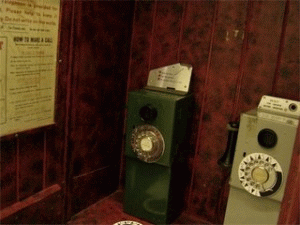 locate a public phone box that wasn’t vandalised. That is, of course, if you had a 5c piece to make a call.
Beepers became more sophisticated with the annoying beep being replaced with an equally annoying little screen that had scrolling text. The office had to ring an agency that would send you a message, and if the operator was busy, she’d use shortened words that made little sense at all. You ended up ringing the office just so they could interpret the message for you. We’d called it ‘texting’ now I guess.
Every message to the beeper was expensive, so it had to be important for them to want to contact you. As a consequence, every time it ‘went off’ the stress levels rose as you knew the message had to be answered asap.
Then the mobile phone was developed.
The ‘pose’ factor was priceless.
I remember when my first company car had a car phone, I used to hope that someone would ring me at the traffic lights, just so I could be seen answering my phone. I know, a bit shallow, but in my defence, I was young.
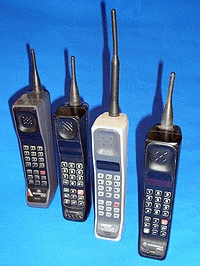 Portable handsets were continually developing. In the early days they were like bricks. Big, heavy and cumbersome, but it was the turning point for communication.
You were constantly in contact. Our first mobile phone cost us $1400 and we purchased two units for our senior sign staff.
How times have changed. The new phones are now as powerful as our home computers. You can surf the web, receive and send emails, take photo’s, send photo’s, store music, download music…. you can even ring someone.
Newer phones have word processing, spreadsheet and database functionality.
Then you only have to look at our sign industry.
Digital signage was a pipe dream not too many years ago.
Computer cut signs were basic at best. Amazing how many of today’s experts started with the old Gerber 4b. Slow but bullet proof.
Innovative companies like 3M saw huge possibilities for the ‘new age’ – vinyl signage. It was to change the traditional sign industry forever. Some would argue it was a backward step, and it probably was a valid point in the ‘old days’ given that nothing at the time was better than a good traditional hand painted sign.
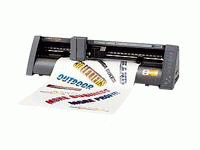
The first hint of how successful the industry would become could be attributed to amazing machines like the Roland PC50. Full colour vector files printed to the little PC50 was enough to impress even the most sceptical industry stalwart.
It was my earliest entry into the world of full colour vinyl printing, and I was hooked. The reliability of the little work horse was truly amazing. Yes it was slow by today’s standard, but at the time, that little machine got me clients 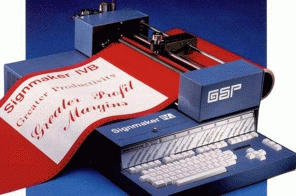 that I would have missed otherwise.
Look at the industry now.
Roland is still the market leader in the very competitive wide format market.
Now, various manufacturers make all sorts of configurations, with machines that print white, clear lacquer and metallics. Not forgetting the types of printing – foil, eco, solvent and latex.
So looking back, has technology made our lives easier?
Initially, the answer is probably yes, but you may be excused for answering no.
Why?
With the modern forms of communication, we’ve gradually developed this attitude that anyone is available any time.
 When phones first became a household item, it was an unwritten rule that you didn’t ring around a meal time.
Now, with mobile phones, people feel they have the right to contact you any hour of the day or night, 7 days a week.
If you don’t have a phone or perhaps an email address, they think you are living in the dark ages.
Through technology, we have play stations, computer games, the internet, online games, social networking and emails.
Our kids prefer to watch sport rather than go out and play it. They don’t talk anymore, preferring to text each other or post messages on Facebook and Twitter. Most kids don’t physically write anymore, once again, opting for short emails or text messages. They don’t even worry about spelling anymore, with the availability of spell checkers on our computers and our phones.
What about technology in our industry?
In this day and age, just about anyone can afford a PC at home. Most have access to graphics programs and they fancy themselves as a graphic designer.
How many times has someone sent you a Microsoft publisher file, expecting you to print a banner for them? Or sent you a postage stamp GIF from the ‘net‘, and want you to wrap their van with it?
I’m not the only one surely.
I’ve had people say to me “It can’t be that hard – ‘it’s only a printer’ after all”.
On the flip side, wide format printing can produce material quickly, consistently, efficiently, economically and with amazing results.
So, can we live without technology? Probably not, but it is nice to be able to reflect on a time when we didn’t have it, when our time was our own and not in demand via easy access by all types of communication.
It doesn’t hurt to appreciate what we have now though.
Shane Drew
www.dsi.net.au
[email protected]

Most read
- Triple EDP award win for Mimaki
- New HP Printer series for busy enterprise environments
- HP Inc. and manroland Goss sign reseller agreement for Digital Finishing Systems
- Fujifilm to cease sales of Acuity Prime and Acuity Ultra products
- Spicers announces plans to acquire Spandex Australia
- New MD for Fujifilm Business Innovation Australia