
Canon delivers ‘wide format smorgasbord’ at FESPA
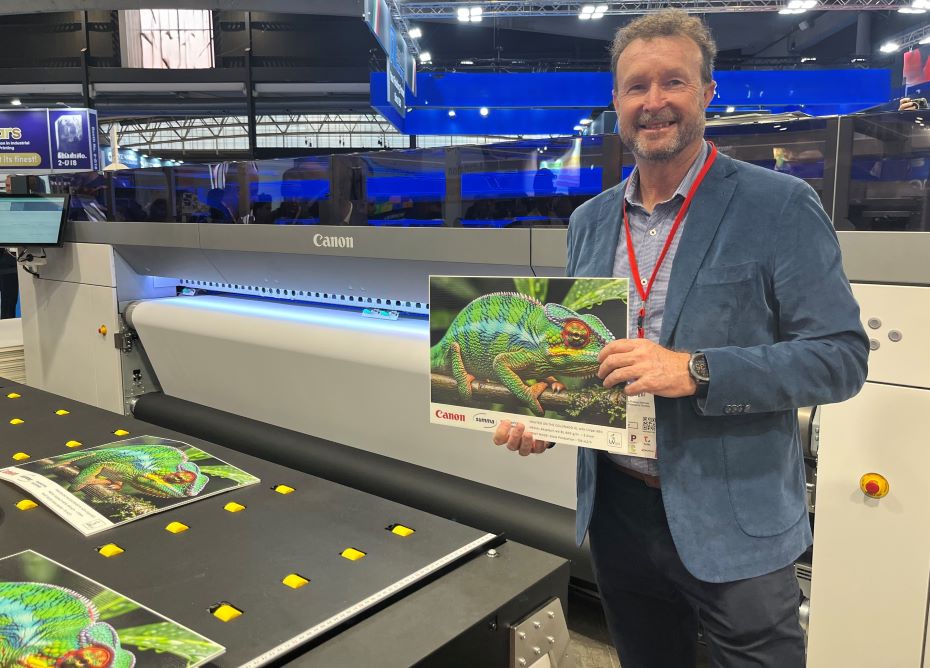
Arguably enjoying one of the busiest stands at FESPA Global Print Expo 2026, Canon used the event to showcase how its wide-format production technologies and customer-led approach combine to create bold, high-impact prints that can transform spaces and connect with audiences. Whilst the stand’s exterior hummed with the sound of printers, like the tried and tested Arizona and the new Colorado XL-series 3.4 m printer (making its European event debut), visitors were steadily enticed further into the stand to see, touch and feel a curated selection of real-world printed applications from across the retail, interior décor, point of sale (POS), corrugated and packaging segments.
Steven Badger, Head of Sales and Professional Services, Canon Production Printing says: “The momentum Canon creates for its customers is achieved through a rich ecosystem of trusted technology and media partners.” He points to Canon’s award-winning Colorado M-series roll-to-roll printer to accentuate his point, at a time when the printer was churning out personalised wallpapers through a fully modular solution (a UVgel Factory) for mass-customised, automated wallpaper production, with UVgel technology at its core, and the Colorado M5W linked to a Fotoba jumbo roll JRL media feeder, output cutter and rewinding taping unit.
Just behind this set-up was the new Colorado XL-series 3.4m printer, latterly snapped up by CMYKhub, which was busy demonstrating its versatility by seamlessly switching between flexible and rigid media applications. Extending the proven advantages of Canon’s UVgel technology to the 3.2m graphics market, the Colorado XL could be seen printing banner, paper, vinyl and films to soft signage, heat-sensitive materials, foam board, fluted polypropylene, acrylic and aluminium composite boards (up to 52mm thick), at print speeds of 70m² per hour in quality mode, 106m² per hour in production mode and up to 211m² per hour in express mode.
“The real advances here are in the printhead evolution,” explains Badger. “Whereas before for our traditional Arizona 6100, which was our flagship flatbed printer, you needed 6 printhead per colour – so 36 printheads for 6-colour work – now the new printers, like the Colorado XL, only need two printeheads for 6-colour work, with a third if you’re adding white ink.”
“It’s also using a tri-drive belt, rather than a straight belt over two pins, so this helps with constant tensioning of the media – a bit of left and right pull and adjustment, as well as smart monitoring, so you get a very stable output.”
“At the end of the day, Canon’s origins are as an imaging company, so there are plenty of smarts sensors built in to the technology, constantly analysing what’s being printed, knowing exactly where each drop should be allocated, so if there is some sort of minor misalignment, it will even slowly adjust the printheads to make sure that you get no banding and that you get that really accurate output.”
Supporting print demonstrations across all its on-stand printers was Canon’s PRISMA XL Suite of workflow solutions. PRISMA XL is an open, flexible workflow that integrates seamlessly with existing systems while supporting PSPs to deliver first-time-right prints and simpler production, even across complex jobs – from file preparation to printing the job, through to shipment. Complementing Canon’s solutions on stand were Canon’s software partners, such as OneVision and Onyx, demonstrating how an open, non-proprietary approach to workflow solutions can increase operational flexibility and profitability.
Whilst hybrid printers like the new Colorado XL clearly hold an important place in market opportunity, Badger was quick to point out that Canon is also delivering continual advancements in its true flatbed Arizona range. “In particular, we’re using AI tools to help simplify the process of creating elevated print,” continues Badger. “In the beginning the idea was to deliver technology that essentially reduced the process to one – for example, enabling printers to no longer need to print vinyl that they then mounted on a rigid board, instead enabling them to print direct to that substrate. But now, using AI integration, linked with a range of Adobe products, you can print direct to substrate, but you can also easily mimic or copy a desired effect, like tiling or stained glass or acoustic panels. Because it’s a true flatbed, and the media is stuck down, you have the ability to repeatedly lay the same image and the smarts behind it are that the printheads are slightly raising each time they pass, which creates the feeling of texture on a flat print.”
Wrapping up, Badger says: “At FESPA, we were essentially able to create an experience designed to support PSPs and packaging converters to make confident decisions when looking for the right technologies and partners to support their next steps. I’m confident that those people who were able to visit our stand saw clear proof of the exciting future of large format print and packaging.”



Most read
- Triple EDP award win for Mimaki
- New HP Printer series for busy enterprise environments
- HP Inc. and manroland Goss sign reseller agreement for Digital Finishing Systems
- Fujifilm to cease sales of Acuity Prime and Acuity Ultra products
- Spicers announces plans to acquire Spandex Australia
- New MD for Fujifilm Business Innovation Australia